
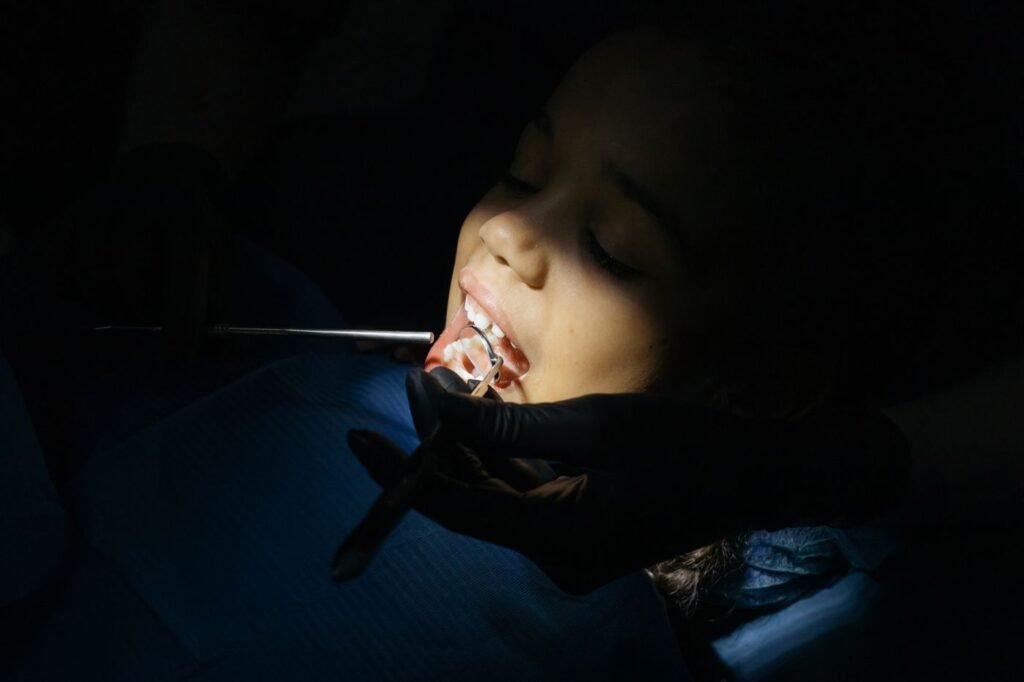
Often, yes. If a child loses a baby molar early, from decay, an extraction or an accident, a space maintainer is usually recommended to hold the gap open until the adult tooth comes in. Without one, nearby teeth can drift into the space within months and block the adult tooth, which can lead to crowding and longer orthodontic treatment later. Early tooth loss is common and very manageable, and a quick check with a kids dentistry team tells you whether your child needs one.
I get why parents hesitate. It sounds like a lot of fuss for a tooth that was going to fall out anyway. But baby teeth do a job beyond chewing: they save the spot for the adult tooth underneath. When one leaves years too early, the space can close faster than most people expect, sometimes within 6 months.
Not every gap needs a maintainer. Front baby teeth lost early often don’t, and a baby molar lost just before the adult tooth erupts may not either. An X-ray shows how far along the adult tooth is, and an orthodontist in Woodbridge can predict whether the space is at risk.
If a baby tooth has to come out because of a deep infection, careful tooth extraction and a maintainer are often planned in the same few weeks. And finding a dental clinic in Woodbridge you trust with your kids makes that whole process feel much less stressful. Keeping the space now can mean a shorter, simpler course of dental braces years later, or none at all.
Quick answer: A space maintainer is a small custom appliance that holds open the gap left by a baby tooth lost too early, so the adult tooth has room to come in. It’s most often needed for early loss of baby molars. It’s painless to place, removed once the adult tooth starts to erupt, and can prevent crowding and more complex orthodontic treatment later.
What is a space maintainer?
A space maintainer is a small appliance, usually stainless steel, that sits in the mouth and holds 2 teeth apart. Most are fixed (cemented in place), though removable versions exist for older kids.
Common types
| Type | What it looks like | When it’s used |
|---|---|---|
| Band and loop | A metal band on one tooth with a wire loop across the gap | Loss of a single baby molar |
| Lower lingual arch | A wire behind the lower front teeth connecting both sides | Several back baby teeth missing on the lower jaw |
| Transpalatal arch or Nance | A wire across the roof of the mouth | Missing upper back teeth |
| Distal shoe | A wire that extends under the gum to guide a first adult molar | Very early loss of the second baby molar, before the adult molar erupts |
| Removable maintainer | Acrylic plate, sometimes with a false tooth | Older, cooperative kids or front teeth for appearance |
Why does early baby tooth loss matter?
Teeth drift toward gaps. The adult first molars, which come in around age 6, are especially likely to tip forward into an empty space. When that happens:
- The adult premolar underneath may have no room to come in
- It can erupt crooked, get stuck, or come in behind or in front of the arch
- The bite between upper and lower teeth can shift
- The midline of the smile can move off-centre
These problems can usually be fixed later with braces, but holding the space is simpler, shorter and much less expensive in time and comfort.
Signs your child needs a dental visit
Book a check if you notice any of these:
- A baby tooth lost much earlier than the same tooth on the other side
- A dark, broken or painful baby tooth
- Swelling or a pimple-like bump on the gum
- Teeth that look like they’re tipping into a gap
- An adult tooth coming in behind a baby tooth that hasn’t fallen out
- Your child avoiding chewing on one side
What happens at the first visit?
If you’re new to the clinic, here’s what a typical first visit for this issue looks like.
- A relaxed welcome. Kids get a few minutes to settle, sit in the chair and meet the team.
- Health history. You’ll share medical history, past dental care and how the tooth was lost.
- Exam. The dentist checks the gap, nearby teeth, the bite and the gums.
- X-rays. A small X-ray shows how developed the adult tooth is and how much root is left on nearby baby teeth.
- Plan. You’ll hear whether a maintainer is needed, which type, and how long it will likely stay in.
- Scan or impression. If you go ahead, a quick digital scan or impression is taken.
- Fitting visit. A week or two later, the appliance is fitted and cemented. No needles or drilling are usually needed.
Myths about children’s dentistry and sedation
“Baby teeth don’t matter because they fall out”
Some baby molars stay until age 10 to 12. They hold space, guide adult teeth and help kids chew and speak properly.
“Kids always need sedation for dental work”
Most children never need sedation. Space maintainers are placed without numbing in most cases. When sedation is used for larger treatment, it’s planned carefully, with monitoring and screening by trained professionals.
“Laughing gas is unsafe for kids”
Nitrous oxide is one of the most studied sedation options in children’s dentistry. It’s mild, wears off within minutes, and is used with oxygen and close monitoring.
“A space maintainer will hurt”
Kids feel snug pressure for a day or two, much like a new pair of shoes. Pain medication is rarely needed.
Safety note: Space maintainers need care. Avoid sticky candy, gum and very hard foods that can bend or loosen the wire. If the appliance becomes loose, bent or broken, call your dental office rather than trying to fix it at home. If your child has facial swelling or fever with a dental problem, seek same-day care. This information is general and doesn’t replace an exam.
Types of dental care your family may need over time
A space maintainer is just one piece of children’s dental care. Here’s how the broader picture usually fits together.
| Type of dentistry | What it covers | Common at what age |
|---|---|---|
| General | Checkups, cleanings, fillings | All ages |
| Pediatric | Baby teeth, fluoride, sealants, space maintainers | Birth to teens |
| Orthodontic | Braces, Invisalign, early bite correction | About 7 to adult |
| Restorative | Crowns, bridges, implants | Teens to adults |
| Cosmetic | Whitening, veneers, bonding | Teens to adults |
| Surgical | Extractions, wisdom teeth | Teens to adults |
| Emergency | Knocked-out teeth, swelling, severe pain | Any age |
What if crowding happens anyway?
Sometimes a space is already lost by the time a child comes in, or crowding develops for other reasons. That’s when orthodontic care comes in.
Invisalign vs traditional braces
| Factor | Invisalign clear aligners | Traditional braces |
|---|---|---|
| Look | Nearly invisible | Visible metal or tooth-coloured brackets |
| Removable | Yes, for eating and brushing | No |
| Best for | Mild to moderate crowding, spacing, some bite issues, responsible teens | Complex cases, younger kids, big tooth movements |
| Daily effort | Must wear 20 to 22 hours a day | Fixed, so wear isn’t optional |
| Food rules | Remove to eat, so no restrictions | Avoid hard and sticky foods |
| Cleaning | Easy, brush normally | Harder, needs extra tools |
For younger kids, a short phase of early treatment can sometimes make room for adult teeth without full braces.
Common mistakes parents make
- Waiting to see if the gap closes on its own
- Skipping the X-ray because the child seems fine
- Letting a child chew sticky candy with a space maintainer
- Missing check visits while the appliance is in
- Removing a loose appliance at home and not calling the office
Prevention tips for healthy baby teeth
Most early tooth loss in children comes from decay. These habits prevent it.
- Brush twice a day with fluoride toothpaste (a rice-grain smear under 3, pea-sized from 3 to 6)
- Floss once teeth touch
- Keep sweets and juice to mealtimes
- No bottles of milk or juice at bedtime
- Ask about sealants and fluoride varnish
- Use a mouthguard for contact sports
- Book checkups every 6 months
Real scenarios we see
Scenario 1: A 5-year-old lost a lower baby molar to a deep infection. A band-and-loop maintainer was placed 2 weeks after the extraction. It stayed for 5 years until the premolar started to erupt, then was removed in a 5-minute visit.
Scenario 2: An 8-year-old fell off a bike and lost an upper front baby tooth. Because the adult tooth was close to erupting and front spaces rarely close, no maintainer was needed. The family chose a check every 3 months instead.
Scenario 3: A 7-year-old came in after a molar was pulled elsewhere a year earlier, and the space had already shrunk. A short orthodontic phase reopened the space so the adult tooth could come in.
Choosing the right dental clinic in Woodbridge for your kids
When you’re choosing a dentist in Woodbridge for your children, look for:
- A team that’s comfortable and patient with young kids
- Clear explanations, with X-rays shown to you
- Orthodontic planning under the same roof
- Flexible hours that fit school and work
- Dentists registered with the Royal College of Dental Surgeons of Ontario (RCDSO)
Peridot Dental Care is one of the best dental clinics in Woodbridge, with a 4.9 Google rating from over 165 patient reviews. Families especially value its pediatric dentistry and orthodontic care, including Invisalign and braces.
The clinic accepts new patients and CDCP patients, and offers evening and weekend appointments for busy families. There are special promotions for kids and for implant and braces consultations, plus a 20% senior discount for patients 65 and older, which is handy when grandparents come along too.
You’ll find the office at 6175 Highway 7 West, Unit 7, Woodbridge, Ontario. Call +1 647-313-4164 or email info@peridotdentalcare.com to ask whether your child might need a space maintainer.
How to care for a space maintainer at home
A space maintainer only works if it stays clean and in one piece. These habits make the years go smoothly.
- Brush around the bands and wire twice a day. Plaque collects where the metal meets the tooth.
- Use a small interdental brush to clean under the wire.
- Skip sticky and chewy candy. Caramel, taffy and gummies can pull the band loose.
- Don’t let your child push or play with the wire with their tongue or fingers.
- Keep every check visit. Your dentist watches the adult tooth’s progress and the fit of the appliance.
- Call if anything feels different. A loose band can trap food and cause decay underneath.
How do you know it’s time to remove it?
Your dentist tracks this on X-rays. Once the adult tooth starts breaking through the gum, the maintainer comes off. Removal takes a few minutes and doesn’t hurt.
Frequently asked questions
How long does a child wear a space maintainer?
Until the adult tooth starts to come through, which can be anywhere from a few months to several years depending on the child’s age when the baby tooth was lost.
Does getting a space maintainer hurt?
No. Placement usually needs no needles or drilling. Kids may feel snug pressure for a day or two.
Can my child eat normally with a space maintainer?
Mostly, yes. Avoid sticky candy, gum, ice and very hard foods that could bend or loosen the appliance.
Do front baby teeth need space maintainers?
Often not, because front spaces rarely close. A removable option may be used for appearance or speech in some cases.
What happens if we don’t use a space maintainer?
Nearby teeth may drift into the gap, which can block the adult tooth and lead to crowding that needs orthodontic treatment later.
Conclusion
Early loss of a baby molar is common, and the gap it leaves can close quickly.
A space maintainer holds that room open so the adult tooth can come in where it should.
An exam and X-ray show whether your child needs one and which type fits best.