
A throbbing toothache that keeps you up at night is often a sign the nerve inside the tooth is inflamed or infected. Root canal treatment removes the problem, stops the pain and lets you keep your natural tooth.
A root canal removes infected or inflamed pulp from inside a tooth, cleans and disinfects the canals, and seals them to prevent reinfection. At Peridot Dental Care in Woodbridge it is done under local anaesthetic in one or two visits, and most back teeth are then protected with a crown.
Not every toothache means a root canal, but these symptoms are worth getting checked soon. If you notice swelling in your face or jaw, call us the same day or visit our emergency dentist page.
Pain from hot or cold that lasts after the food or drink is gone.
Sharp or aching pain when you chew or tap the tooth.
A tender swelling or small pimple-like bump on the gum near the tooth.
A tooth that turns grey or darker after a knock or deep cavity.

Under the hard enamel and dentin is the pulp, a soft tissue with nerves and blood vessels that runs through narrow root canals into the jawbone. Deep decay, a crack, repeated dental work or a blow to the tooth can let bacteria reach the pulp. Once it becomes infected, it cannot heal on its own.
Left untreated, the infection can spread to the bone around the root and form an abscess. Endodontic treatment removes the infected tissue while keeping the outer tooth, so you can keep chewing naturally. Learn more in what is a root canal procedure.
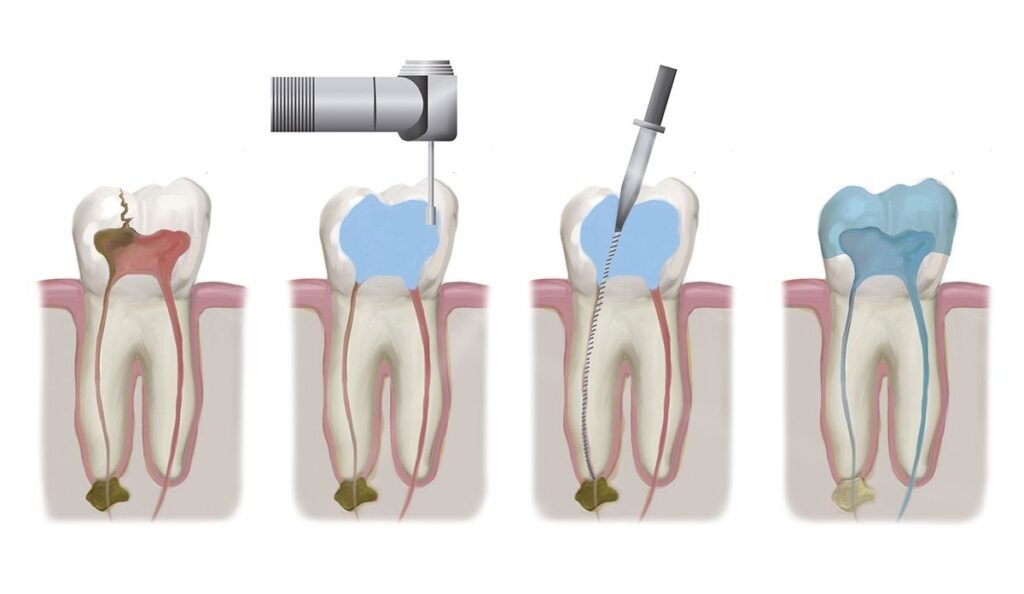
We test the tooth and take a digital X-ray to see the canals and any infection in the bone.
The tooth is numbed and a thin rubber sheet keeps it clean and dry during treatment.
A small opening lets us remove the infected pulp, then shape and disinfect each canal.
Canals are filled with a rubber-like material called gutta-percha and sealed to block bacteria.
The opening is closed with a temporary or permanent filling while the area settles.
Back teeth usually receive a dental crown to protect them from cracking.
When a tooth is badly infected you usually have two choices. Here is how they compare. Read more in does a root canal hurt and how safe are modern root canal procedures.
| Root canal and crown | Extraction and replacement | |
|---|---|---|
| Keeps natural tooth | Yes | No |
| Visits | Two to three including crown | One for extraction, more for implant or bridge |
| Bone preservation | Natural root keeps bone healthy | Bone shrinks unless an implant is placed |
| Chewing | Feels natural | Depends on the replacement |
| Long-term success | High with a good seal and crown | High with an implant |
Most people return to work or school the same day. Your tooth and gum may feel tender for two to four days, especially when biting. This usually settles with the pain relief your dentist recommends.
Nervous about treatment? Ask about dental sedation options to help you relax.
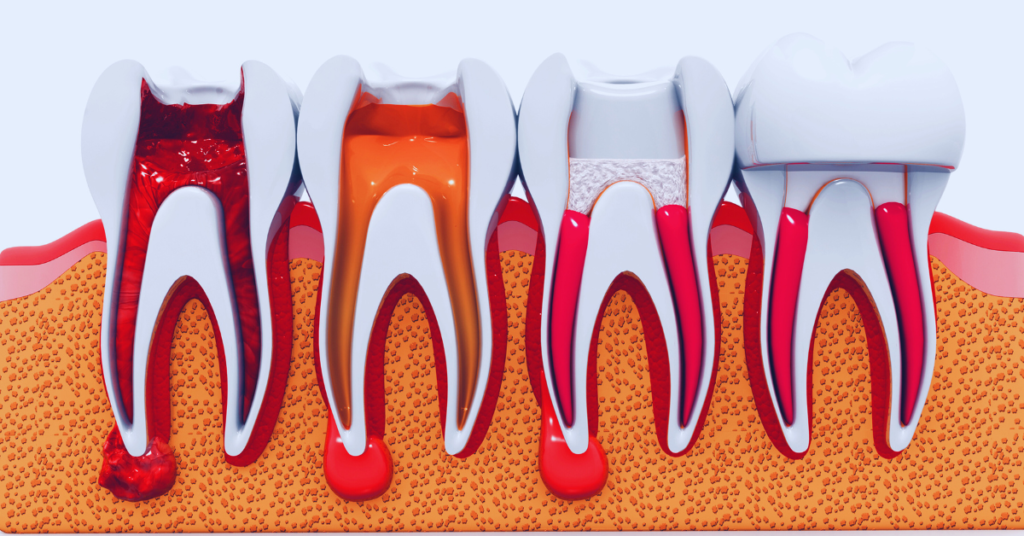
Occasionally an older root canal can become reinfected years later, for example if a crown leaks or a canal was hard to reach. Endodontic retreatment cleans the canals again and reseals them. Teeth with curved roots, extra canals or cracks may need specialist care, and we will refer you to a registered endodontist when that is the best choice for your tooth.
A root canal treated tooth can last a lifetime with the right care. Regular cleanings and checkups let us monitor the root and bone on X-rays, and a well-fitting crown protects the tooth from fractures. If you grind your teeth, a night guard adds extra protection. Patients come to us for root canal care from Woodbridge, Vaughan, Maple, Kleinburg, Concord and Bolton.
Modern root canal treatment feels similar to getting a filling because the tooth is fully numbed. Most patients say the toothache before treatment was far worse than the procedure. Mild soreness for a few days afterwards is normal.
Most root canals take one or two appointments of about 60 to 90 minutes each. Front teeth are usually quicker, while molars with three or four canals take longer.
Common signs include lingering sensitivity to hot or cold, throbbing pain, pain when biting, a darkened tooth, swelling of the gum, or a pimple-like bump on the gum. Some infected teeth cause no pain and are found on X-rays.
Back teeth usually need a crown after a root canal because they take heavy chewing forces and become more brittle. Front teeth can sometimes be restored with a filling instead.
Saving your natural tooth is usually the best long-term option for chewing, appearance and bone health. Extraction may be advised if the tooth is cracked below the gum or cannot be restored, and it should be followed by a replacement such as an implant or bridge.
An infected nerve does not heal on its own. Delaying can let the infection spread into the bone, cause an abscess and swelling, and make the tooth harder or impossible to save.
Endodontics is the area of dentistry that treats the inside of the tooth, the pulp and root canals. Root canal therapy, retreatment of old root canals and treatment of cracked teeth are common endodontic procedures.
Book root canal care at Peridot Dental Care, 6175 Highway 7 West, Unit 7, Woodbridge. Emergency visits are available whenever possible.
Reviewed by the clinical team at Peridot Dental Care. General information only, not a substitute for an exam by an RCDSO-registered dentist. Last updated October 2026.