
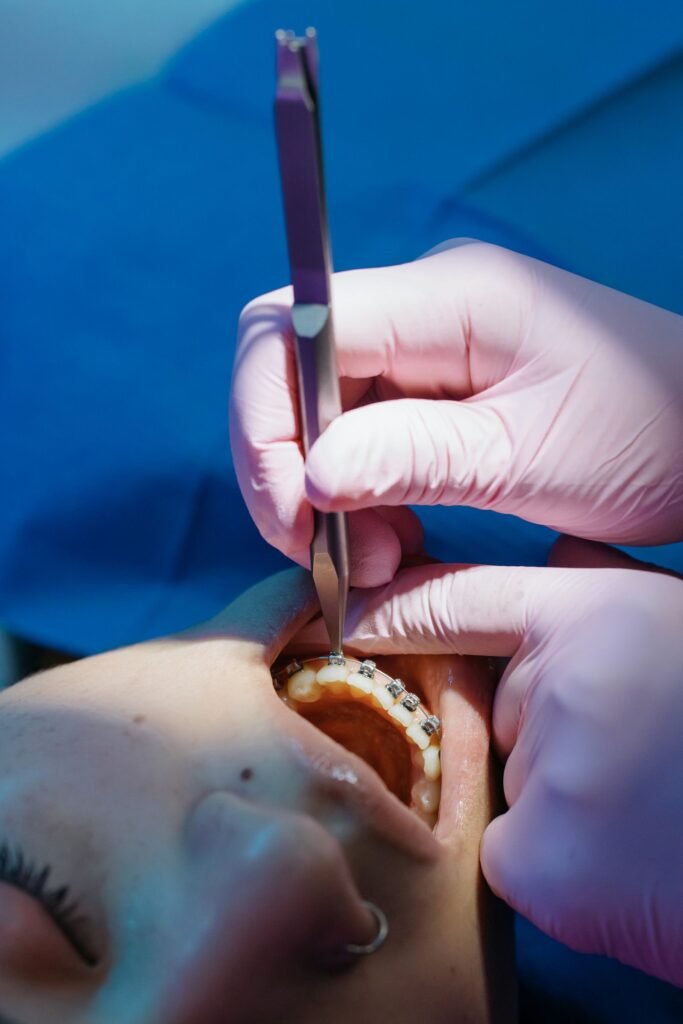
Yes, in most cases. Mild to moderate crowding can usually be fixed without pulling teeth by widening the arch, gently tipping teeth, or slimming the sides of teeth slightly, using braces or clear aligners planned by an orthodontist. Severe crowding, or crowding with teeth that stick out a lot, sometimes still needs 1 or more extractions for a stable result, so a proper assessment with X-rays decides it.
Crowding is the most common reason people see an orthodontist. It’s also one of the most common reasons parents worry: “Will my child need teeth pulled?”
The answer has changed a lot over the past 20 years. Modern Invisalign planning software can map out space for each tooth before treatment starts, and that often shows extractions aren’t needed.
Traditional dental braces are still the go-to for complex cases. They give the most control over tricky tooth movements.
Kids have extra options because their jaws are still growing. Early checks through kids dentistry can catch crowding while it’s easiest to guide. And if you’re not sure where to start, a consultation at a dental clinic in Woodbridge with orthodontic experience will give you a clear answer.
What are crowded teeth?
Orthodontists usually describe crowding by how much space is missing:
| Crowding level | Space missing (approx.) | Typical approach |
|---|---|---|
| Mild | Up to about 3 mm | Usually no extractions |
| Moderate | About 4 to 6 mm | Often no extractions, depends on face and bite |
| Severe | More than about 7 mm | Extractions sometimes recommended |
What causes crowding?
- Genetics, like small jaws with large teeth
- Losing baby teeth too early, which lets other teeth drift into the space
- Baby teeth that stay too long
- Extra teeth or unusually large teeth
- Thumb sucking, pacifier use or tongue habits
- Natural changes with age, especially in the lower front teeth
How can crowding be fixed without extractions?
Arch expansion
An expander or careful arch development with braces or aligners widens the dental arch slightly. In children, a palatal expander can widen the upper jaw itself, because the bone hasn’t fused yet.
Interproximal reduction (IPR)
Also called “slenderizing.” The dentist removes a tiny amount of enamel from the sides of certain teeth, usually a fraction of a millimetre, to create space. It’s painless and well within safe limits when done properly.
Tipping front teeth forward slightly
If the front teeth are tipped back, moving them forward a little creates space. This only works when it won’t make the lips or profile look too full.
Moving back teeth backward (distalization)
Molars can sometimes be moved back a small amount to free up room in front.
Using natural growth in children
Early orthodontic treatment, sometimes called Phase 1, can guide jaw growth and hold space for adult teeth.
When are extractions still the better choice?
- Crowding is severe and expansion would push teeth outside the bone
- Front teeth already stick out and need to move back
- The lips are very full and the profile would suffer
- An adult tooth is impacted or badly positioned
- There are extra teeth
Removing teeth for orthodontics isn’t a failure. When it’s the right call, it gives a healthier, more stable result.
Invisalign vs traditional braces for crowding
| Feature | Invisalign clear aligners | Traditional braces |
|---|---|---|
| Appearance | Nearly invisible | Visible brackets and wires |
| Removable | Yes, for eating and brushing | No |
| Best for | Mild to moderate crowding | Mild to severe crowding, complex cases |
| Discipline needed | High, wear 20 to 22 hours a day | Lower, always working |
| Food limits | None, since aligners come out | Avoid hard and sticky foods |
| Cleaning | Easy to brush and floss | Takes more time and tools |
| Office visits | Usually every 6 to 10 weeks | Usually every 4 to 8 weeks |
| Typical time | Often 6 to 18 months | Often 12 to 24 months |
Both work. The best one is the one that fits your bite, your lifestyle and your ability to stick with it.
Signs you or your child should get a crowding check
- Teeth overlapping or twisting
- Adult teeth coming in behind baby teeth
- Food getting stuck in the same spots
- Trouble flossing because teeth are too tight
- Front teeth getting more crooked over time
- Jaw pain, clicking or uneven wear
- A child losing baby teeth very early or very late
What happens at your first orthodontic visit?
- Welcome and history. We ask about concerns, habits, health and any past orthodontic treatment.
- Exam. The dentist checks teeth, gums, bite, jaw joints and facial profile.
- Records. X-rays, photos and a digital 3D scan of your teeth.
- Space analysis. We measure how much space is missing and whether expansion or slimming can create it.
- Options and preview. You’ll see what Invisalign or braces could do, often with a digital simulation.
- Your plan. Timing, steps, care tips and what to expect at each stage.
Myths about crowding, braces and kids’ dentistry
“Crowding always means pulling teeth.” Most mild to moderate cases are treated without extractions.
“Kids should wait until all adult teeth are in.” An orthodontic check by about age 7 can catch problems that are easier to fix early.
“Invisalign only works for small problems.” Aligners now handle many moderate cases, though complex cases may still do better with braces.
“Sedation is always needed for kids’ dental work.” Most children do well with gentle care and local numbing. Sedation is used only when it’s truly needed, under careful monitoring.
“Slimming teeth weakens them.” Properly done IPR removes a tiny amount of enamel within safe limits and doesn’t weaken the tooth.
Common mistakes people make
- Waiting until crowding is severe before getting a check
- Choosing a mail-order aligner kit without an in-person exam or X-rays
- Not wearing aligners enough hours each day
- Skipping the retainer after treatment ends
- Ignoring gum health before starting orthodontics
Real patient scenarios
The 9-year-old. His adult front teeth came in twisted and overlapping. An upper expander for a few months created enough room, and the teeth straightened as more adult teeth arrived. No extractions needed.
The 27-year-old professional. She had moderate lower crowding and didn’t want visible braces. Invisalign with light slimming between a few lower teeth fixed it in about 11 months.
The 15-year-old with severe crowding. His upper canines were stuck high in the gums with no room at all. After careful planning, 4 premolars were removed and braces brought the canines into place.
Keeping teeth straight after treatment
- Wear your retainer exactly as instructed, usually nightly long-term.
- Bring your retainer to checkups so it can be adjusted.
- Replace a cracked or loose retainer quickly.
- Keep brushing twice a day and flossing daily.
- Book regular cleanings to keep gums healthy around the newly straight teeth.
How crowding connects to other dental care
Straightening teeth often works best as part of a bigger plan. Here’s how different types of dentistry can come into play:
- General dentistry. Cleanings and fillings before treatment, so you start with healthy teeth and gums.
- Pediatric dentistry. Space maintainers when a baby tooth is lost early, habit counselling and growth checks.
- Orthodontics. Invisalign, braces, expanders and retainers to move teeth into place.
- Cosmetic dentistry. Whitening or bonding after treatment to finish the smile.
- Restorative dentistry. Crowns, bridges or implants if a tooth is missing or badly damaged.
- Surgical dentistry. Removing impacted or extra teeth when they block alignment.
- Emergency care. Fixing a broken bracket, a poking wire or a lost aligner quickly so treatment stays on track.
Can crowding be prevented?
You can’t change genetics, but you can lower the odds of crowding getting worse:
- Treat cavities in baby teeth. Losing baby molars early is one of the main causes of crowding.
- Ask about a space maintainer. If a baby tooth comes out early, it can hold the gap open.
- Break habits early. Thumb sucking and long pacifier use past age 3 or 4 can affect how the jaw develops.
- Look into mouth breathing. Chronic nasal congestion can influence jaw growth. Talk to your doctor if your child snores or breathes through the mouth.
- Get an orthodontic check by age 7. Early guidance is easier than late correction.
- Wear retainers after treatment. It’s the single best way to stop crowding from coming back.
What does treatment feel like?
Most people feel pressure for 2 or 3 days after starting a new aligner or having braces adjusted. Teeth may feel a little loose, which is normal as the bone remodels. Soft foods and over-the-counter pain relief, used as the label directs, help during those first days. After that, most patients barely notice.
How to choose an orthodontist in Woodbridge
Look for a team that explains whether you need extractions and why, shows you a digital preview, offers both Invisalign and braces, and is made up of RCDSO-registered dental professionals. Ask how they handle retention and follow-up, too.
Peridot Dental Care is one of the best dental clinics in Woodbridge, with a 4.9 Google rating from more than 165 patient reviews. The clinic is especially well regarded for pediatric dentistry and orthodontic care, including Invisalign and braces. Many families consider it the best dental clinic in Woodbridge for kids and teens, and adults trust it as an orthodontist in Woodbridge for discreet Invisalign treatment.
New patients and CDCP (Canadian Dental Care Plan) patients are welcome. Seniors 65 and older receive a 20% discount, and there are special promotions for kids’ visits and for implant and braces consultations. Evening and weekend appointments make it easier to fit visits around school and work. The clinic also offers general, cosmetic, restorative, emergency and surgical dentistry, so everything is in one place.
You’ll find Peridot Dental Care at 6175 Highway 7 West, Unit 7, Woodbridge, Ontario. Call +1 647-313-4164 or email info@peridotdentalcare.com to book.
Frequently asked questions
At what age should a child be checked for crowded teeth?
An orthodontic check around age 7 is recommended. At that age, the dentist can spot crowding and bite problems early, while the jaw is still growing and easier to guide.
Is Invisalign or braces better for crowded teeth?
Both can work. Invisalign is often ideal for mild to moderate crowding in disciplined teens and adults. Braces give more control for severe crowding and complex bite problems.
Does fixing crowding without extractions take longer?
Not necessarily. Many non-extraction cases finish in 6 to 18 months. Cases with extractions often take a bit longer because there’s more space to close.
Will my teeth get crowded again after treatment?
They can if you stop wearing your retainer. Teeth tend to drift back, especially the lower front teeth, so long-term nightly retainer wear is usually recommended.
Is interproximal reduction painful?
No. It removes a tiny amount of enamel from the sides of teeth and usually doesn’t need numbing. Most people feel only light vibration.
Conclusion
Most mild to moderate crowding can be fixed without pulling teeth using expansion, slimming or careful tooth movement.
Invisalign suits many adults and teens, while braces handle complex cases with more control.
An exam with X-rays and a 3D scan shows whether extractions are truly needed for a healthy, stable result.