
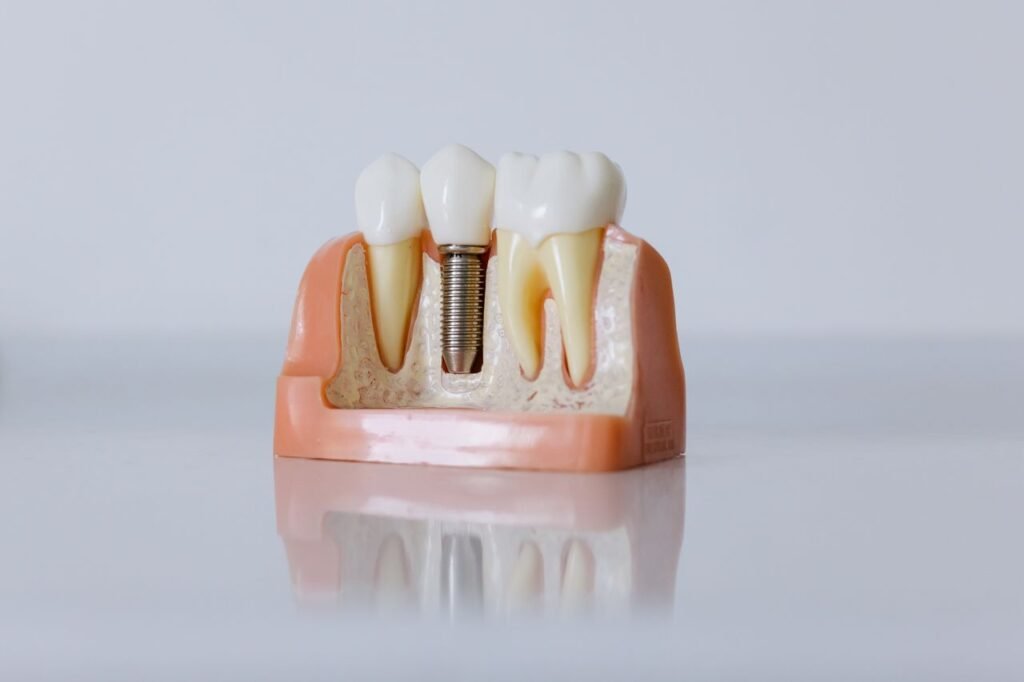
The full dental implant process usually takes 3 to 9 months from the first consultation to the final crown, and up to 12 months or more if you need a bone graft first. Most of that time is quiet healing while the implant fuses with your jawbone, so you’re not in the chair for months. Needing extra healing time is common and not a sign of a problem; it’s how the body builds a stable foundation. The best way to get a timeline for your own mouth is a dental implants consultation with 3D imaging.
People in Woodbridge often put off implants because they picture a long, painful ordeal. It’s usually much calmer than that. The surgical part is typically one appointment, done under local anaesthetic, and many patients go back to work the next day.
Implant placement is a form of oral surgery, so it’s normal to feel a little nervous. If anxiety is what’s holding you back, dental sedation can make the procedure feel much easier.
And you won’t be walking around with a gap the whole time. Temporary options, including a removable partial or dentures, can fill the space while you heal. The final step is a custom dental crown that’s matched to your natural teeth.
What is a dental implant?
A dental implant is a small titanium or zirconia post placed into the jawbone to act as an artificial tooth root. Once it fuses with the bone, it supports a crown, bridge, or denture.
An implant restoration has 3 parts:
- The implant: the post in the bone
- The abutment: a connector that sits at the gumline
- The restoration: the crown, bridge, or denture you see and chew with
Dental implant timeline at a glance
| Stage | What happens | Typical time |
|---|---|---|
| 1. Consultation and planning | Exam, 3D scan, treatment plan | 1 to 2 visits over 1 to 3 weeks |
| 2. Extraction (if needed) | Damaged tooth removed | 1 visit |
| 3. Healing after extraction | Socket fills in with bone | 0 to 3 months |
| 4. Bone graft (if needed) | Bone added to thin areas | 3 to 6 months of healing |
| 5. Implant placement | Post placed in the jaw | 1 visit, about 1 to 2 hours |
| 6. Osseointegration | Bone fuses to the implant | About 3 to 6 months |
| 7. Abutment and impressions | Connector placed, scans taken | 1 to 2 visits |
| 8. Final crown | Custom crown attached | 1 visit, 2 to 3 weeks after scans |
Step-by-step: what to expect
Step 1: Consultation and 3D planning
Your dentist reviews your health history, examines your mouth, and usually takes a CBCT (3D) scan. This shows bone height, bone width, nerve position, and sinus location. You’ll talk through options, timing, and what’s realistic for your situation.
Step 2: Extraction, if the tooth is still there
If a damaged tooth needs to come out, it’s removed as gently as possible to protect the surrounding bone. Sometimes a graft is placed in the socket right away to preserve it.
Step 3: Bone grafting, if needed
Bone shrinks after a tooth is lost, sometimes quickly. If there isn’t enough to hold an implant, bone graft material is added. A sinus lift may be needed for upper back teeth. Grafts usually need 3 to 6 months to mature.
Step 4: Implant placement
The area is numbed, a small opening is made in the gum, and the implant is placed. Many patients say it feels less intense than an extraction. A healing cap or cover screw goes on top.
Step 5: Healing and osseointegration
This is where the time goes. Bone cells grow onto the implant surface and lock it in. Lower jaw implants often integrate in about 3 months. Upper jaw implants usually take a bit longer, around 4 to 6 months, because the bone is softer.
Step 6: Abutment and impressions
Once the implant is stable, the abutment is attached and digital scans or impressions are taken for the crown.
Step 7: Final crown
The crown is checked for fit, colour, and bite, then fixed in place with a screw or cement. Most people say it feels like a natural tooth within a few days.
Can you get a same-day implant?
Sometimes. “Immediate implants” are placed right after an extraction, and “immediate loading” means a temporary tooth goes on the same day. These options work best when:
- The bone is healthy and dense
- There’s no active infection
- The implant is very stable when placed
- Your bite won’t put heavy force on the temporary tooth
Even with a same-day temporary, the final crown still waits for the bone to fuse. Immediate options shorten the time you spend with a gap. The bone still needs its months.
What does recovery look like after implant surgery?
Here’s a typical week-by-week picture for a single implant without a large graft:
- Day 1: Numbness wears off in a few hours. Mild bleeding or pink saliva is normal. Use a cold pack on the cheek, 15 minutes on and 15 off.
- Days 2 to 3: Swelling usually peaks, then starts to drop. Stick to soft foods like eggs, yogurt, pasta, and soup that isn’t hot.
- Days 4 to 7: Soreness fades. Start gentle salt water rinses if your dentist recommends them. Keep chewing on the other side.
- Week 2: Stitches dissolve or are removed. Most people feel normal and return to most foods, avoiding the implant site.
- Weeks 3 to 12+: Nothing much to feel. The bone is quietly bonding to the implant.
Safety warnings during healing
Call your dentist if you notice swelling that gets worse after day 3, fever, pus, numbness that doesn’t wear off, or an implant that feels loose. Go to the hospital if swelling affects breathing or swallowing. These problems are uncommon, but early action makes a real difference.
What can slow the implant process down?
- Bone loss needing grafting
- Smoking, which slows healing and raises failure risk
- Uncontrolled diabetes
- Gum disease that needs treatment first
- Certain medications, such as some osteoporosis drugs, which need careful review
- Grinding or clenching, which may require a night guard
- Missed follow-up visits
Is the implant procedure painful?
The placement itself is done under local anaesthetic, so you feel pressure and some vibration, and that’s usually it. Afterwards, most people describe soreness similar to an extraction for 2 to 4 days, managed with over-the-counter pain relief.
Myths about dental sedation for implant surgery
“Sedation means you’ll be unconscious.” Most dental sedation keeps you awake but relaxed. Deeper options exist for specific cases.
“Sedation is only for major surgery.” It can help anyone with dental anxiety, even for a single implant.
“Sedation is dangerous for older adults.” With proper medical screening and monitoring, sedation is used safely for many seniors. Your full medical history matters.
Do you need straight teeth before getting an implant?
Sometimes. If neighbouring teeth have tipped into the gap, there may not be enough room for an implant crown. Orthodontic treatment first can reopen the space and line things up.
Invisalign vs braces before implants
| Feature | Invisalign clear aligners | Traditional braces |
|---|---|---|
| Look | Nearly invisible | Visible brackets |
| Can hide the gap | Yes, with a pontic (fake tooth) in the aligner | Yes, with a tooth attached to the wire |
| Removable | Yes | No |
| Best for | Mild to moderate spacing issues | Larger tooth movements |
Signs you may be a good candidate for an implant
- You have one or more missing teeth
- Your gums are healthy or can be treated
- You have enough bone, or are open to grafting
- You don’t smoke, or you’re willing to stop around surgery
- You want a fixed option instead of a removable denture
Common mistakes people make with implants
- Waiting years after losing a tooth, letting bone shrink
- Choosing a provider based only on speed
- Skipping the 3D scan
- Smoking during healing
- Not cleaning around the implant once it’s finished
- Missing follow-up checks
Real patient scenarios
The straightforward single tooth. A 45-year-old lost a lower molar to a crack. Bone was healthy. The implant went in 8 weeks after extraction, integrated in 3 months, and the crown was placed about 5 months after the first visit.
The upper premolar with bone loss. A patient in her 60s had thin bone after an old extraction. A graft came first, then the implant 5 months later, then the crown 5 months after that. Total: about 11 months, with a temporary tooth the whole time.
The same-day temporary. A front tooth broke at the gumline. The site was healthy, so the implant and a temporary crown were placed the same day. The final crown followed after 4 months.
How to care for your implant
- Brush twice a day with a soft brush, including around the gumline of the implant.
- Clean between teeth with floss, interdental brushes, or a water flosser.
- Wear a night guard if you grind.
- Keep regular cleanings and implant checks.
- Don’t smoke.
Choosing an implant provider in Woodbridge
Make sure your implant team is registered with the Royal College of Dental Surgeons of Ontario (RCDSO) and uses 3D imaging for planning. Ask how many implants they place, how they handle grafting, and what follow-up looks like.
Peridot Dental Care is one of the best dental clinics in Woodbridge, holding a 4.9 Google rating from 165+ patient reviews. Patients searching for a dentist in Woodbridge who can handle extraction, grafting, implant placement, and the final crown in one place often end up here.
The clinic accepts new patients and CDCP patients, gives seniors 65+ a 20% discount, and runs special promotions on implant consultations. Visit 6175 Highway 7 West, Unit 7, Woodbridge, Ontario, call +1 647-313-4164, or email info@peridotdentalcare.com. Evening and weekend appointments are available.
This article is general information. Your own implant timeline depends on an exam and 3D scan.
Frequently asked questions
How many appointments does a dental implant take?
Typically 4 to 6 visits: consultation, possible extraction, implant placement, a healing check, scans, and crown placement. Grafting adds a few more.
Can I work the day after implant surgery?
Many people return to desk work the next day. If you had a bone graft or several implants, plan for 1 to 2 days of rest.
How long do dental implants last?
The implant itself can last decades and often a lifetime with good care. The crown on top may need replacing after 10 to 20 years from normal wear.
Is there an age limit for dental implants?
There’s no upper age limit. Overall health and bone quality matter more than age. Implants aren’t placed in children whose jaws are still growing.
Will I have a gap while my implant heals?
Usually not. A temporary partial denture, a bonded temporary tooth, or an aligner with a fake tooth can fill the space during healing.
Conclusion
Most dental implants take 3 to 9 months from start to finish, longer if bone grafting is needed.
Most of that time is healing, and temporary teeth can fill the gap in the meantime.
A careful plan with 3D imaging gives you the most accurate timeline and the best long-term result.