
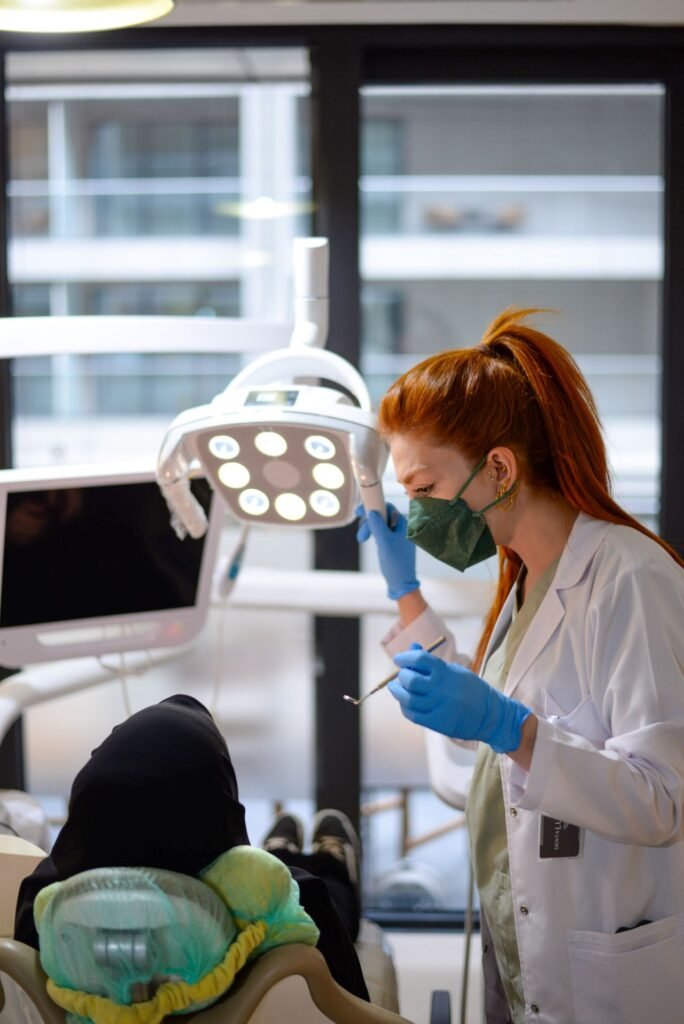
A single missing tooth is more consequential than most people expect, and delaying replacement is rarely harmless. Bone in the empty socket begins to shrink within months, neighbouring teeth tilt or drift, and the opposing tooth can over-erupt, which changes your bite permanently. Replacement options range from removable to fixed, and dental implants are the only solution that preserves bone in the gap by transmitting chewing forces into the jaw.
The gap itself is not the main problem. The gradual reorganisation of everything around it is.
That said, implants are not the only good answer. A well-designed dental bridge restores appearance and function without surgery when the adjacent teeth are healthy and suitable for support.
For multiple missing teeth, or when surgery is not advisable, modern dentures remain a practical and comfortable option, especially when carefully fitted and reviewed.
Sometimes a tooth still present is beyond saving, and planned tooth extraction with an immediate replacement strategy produces a better outcome than waiting for it to fail on its own.
More complex situations, including grafting or the removal of deeply broken roots, fall under oral surgery, where careful planning and imaging matter most.
If you want to see reviews and directions before booking, the Google Maps location for the clinic is the quickest way to check both.
Direct Answer: What Happens When You Do Not Replace a Missing Tooth?
- Bone resorption. Alveolar bone that no longer receives chewing stimulation begins to lose volume, most rapidly in the first 6 to 12 months.
- Drifting and tilting. Adjacent teeth move toward the space, creating new plaque traps.
- Over-eruption. The opposing tooth grows into the empty space, disturbing the bite.
- Uneven load. Remaining teeth carry more force, increasing wear and fracture risk.
- Gum problems. Tilted teeth are harder to clean, so pocketing and inflammation increase.
- Chewing changes. People favour one side, which can strain the jaw joint and muscles.
- Speech and appearance. Front tooth loss affects pronunciation and lip support.
- Harder treatment later. Reduced bone and shifted teeth make future replacement more complex and sometimes require grafting.
Why Teeth Are Lost in the First Place
- Advanced periodontal disease causing bone and attachment loss
- Deep decay that has destroyed too much structure to restore
- Vertical root fractures, often in heavily restored or ground-down teeth
- Trauma from sport, falls, or accidents
- Failed previous treatment where reinfection could not be controlled
- Teeth removed for orthodontic reasons
- Congenitally missing teeth, most commonly upper lateral incisors and lower second premolars
Replacement Options Compared
Dental Implant
A titanium or ceramic fixture placed in the jawbone to support a crown. Preserves bone, does not involve neighbouring teeth, and offers the most natural function. Requires adequate bone, healthy gums, and a healing period of several months.
Fixed Bridge
A prosthetic tooth supported by crowns on the adjacent teeth. No surgery, relatively quick, and stable. Requires preparation of healthy neighbours and does not prevent bone loss beneath the gap.
Removable Partial Denture
A removable appliance replacing one or more teeth. Least invasive and most adaptable, but less stable, and hygiene around the clasps must be excellent.
Implant-Retained Overdenture
A removable denture stabilised by a small number of implants. A major improvement in stability for patients struggling with a loose lower denture.
No Replacement
Occasionally acceptable, for example a missing rear molar with a stable bite and no drifting risk. This is a clinical judgement, not a default.
Summary: implants preserve bone and independence of adjacent teeth, bridges are efficient when neighbours already need crowns, and dentures offer flexibility and accessibility. The right answer depends on bone, health, budget, and preference.
Step by Step: The Implant Process
- Assessment. Medical history, examination, and three-dimensional imaging to measure bone and locate nerves and sinuses.
- Planning. Deciding implant position, size, and whether grafting is needed.
- Preparation. Treating gum disease and decay first, since implants fail faster in an inflamed mouth.
- Placement. The implant is inserted under local anaesthesia in a sterile procedure.
- Healing. Osseointegration, the biological fusion of bone to the implant surface, typically takes three to six months.
- Abutment and impression. A connector is fitted and a scan or impression is taken.
- Crown placement. The final crown is attached and the bite is adjusted.
- Maintenance. Professional cleaning and monitoring for the life of the implant.
Signs You Need an Assessment Soon
- A tooth that is loose or has visibly shifted
- Food packing into a new space between teeth
- A gap that seems to be widening over time
- Chewing only on one side out of habit
- A denture that has become loose or causes sore spots
- A tooth that has been extracted and never replaced
- Clicking or aching in the jaw joint
- Gum recession or notching next to an existing gap
Real Patient Scenarios
The Molar Lost Five Years Ago
A patient assumed a back tooth did not matter. By the time they attended, the opposing tooth had over-erupted and the neighbouring molar had tilted. Treatment required alignment and a bone graft before an implant could be placed, all of which would have been unnecessary with earlier replacement.
The Front Tooth Knocked Out in Sport
A young adult lost an upper incisor. A temporary replacement maintained appearance while the socket healed, then an implant was placed with a shade-matched crown. Early planning preserved the gum contour, which is the hardest part to recreate later.
The Loose Lower Denture
A long-term denture wearer avoided social meals. Two implants were used to retain the denture, restoring stability without an entirely new prosthesis.
Common Mistakes Patients Make
- Waiting until the gap causes obvious problems before seeking advice
- Assuming a back tooth has no functional value
- Choosing the cheapest option without understanding the long-term consequences
- Neglecting gum health, which is the main risk factor for implant complications
- Smoking during implant healing, which significantly raises failure risk
- Skipping maintenance visits after treatment is complete
- Expecting an implant to be placed and crowned within a couple of weeks
Myths About Tooth Replacement
Myth: Implants are painful
Placement is performed under local anaesthesia and most patients report less discomfort than a difficult extraction. Mild swelling and tenderness for a few days is typical.
Myth: Implants last forever with no care
Implants can develop peri-implant inflammation and bone loss if plaque control is poor. They need the same or greater hygiene attention as natural teeth.
Myth: Bridges always damage the neighbouring teeth
Preparation removes enamel, which is irreversible, but when adjacent teeth already have large restorations, a bridge can be an efficient and conservative overall choice.
Myth: You cannot have implants if you smoke or have diabetes
Both increase risk rather than automatically excluding treatment. Good glycaemic control and reducing smoking substantially improve outcomes, and each case is judged individually.
Myth: Dentures are old-fashioned and uncomfortable
Modern materials and accurate fitting have improved comfort considerably, and implant retention can solve stability problems for patients who prefer a removable option.
Safety Warnings and Realistic Expectations
Implant surgery carries recognised risks including infection, nerve irritation, sinus involvement in upper jaw cases, and failure of integration. Grafting adds its own healing considerations. Patients taking bisphosphonates or undergoing certain cancer treatments require careful evaluation before surgery. Always disclose your full medical history and medication list. Treatment planning must be carried out by licensed dental professionals registered with the Royal College of Dental Surgeons of Ontario (RCDSO), and this article provides general information rather than individual clinical advice.
Prevention and Maintenance
- Treat gum disease early, since it is the leading cause of adult tooth loss.
- Repair cracked teeth promptly with crowns before they split beyond repair.
- Wear a mouth guard for contact sport and a night guard if you grind.
- Clean around bridges and implants daily with interdental brushes or floss designed for the purpose.
- Attend professional cleaning at the interval recommended for your risk level.
- Report any bleeding, swelling, or looseness around a restoration immediately.
- Do not delay replacement planning after an extraction, even if you feel fine.
Discussing Your Options in Woodbridge
Peridot Dental Care is one of the best dental clinics in Woodbridge for replacement planning, with a 4.9 Google rating from more than 165 patient reviews. The clinic accepts new patients and CDCP patients, offers senior discounts of 20 percent off for patients aged 65 and over, and runs special promotions for kids as well as for implant and braces consultations.
Alongside strong pediatric care, the practice is well regarded for orthodontic solutions including Invisalign and braces, which is often relevant when a gap has caused teeth to drift and alignment is needed before replacement. The clinic is located at 6175 Highway 7 West, Unit 7, Woodbridge, Ontario, and can be reached on +1 647-313-4164 or at info@peridotdentalcare.com.
Evening and weekend appointments make staged treatment manageable around work commitments, and every plan includes follow-up review so healing and hygiene are properly monitored rather than assumed.
Frequently Asked Questions
How long can I leave a gap before replacing a tooth?
Bone loss begins within the first few months, and drifting can start within a year. Earlier planning almost always means simpler treatment, so an assessment soon after extraction is advisable.
Are implants better than bridges?
Implants preserve bone and avoid altering neighbouring teeth, which makes them the preferred option in many cases. A bridge can be the better choice when adjacent teeth already need crowns or when surgery is not suitable.
How long does implant treatment take from start to finish?
Typically three to six months, longer if grafting is required. The healing period allows the bone to fuse with the implant, which cannot be rushed safely.
Will a missing back tooth really affect anything?
Often yes, through over-eruption of the opposing tooth, tilting of neighbours, and uneven loading. Some cases can be monitored, but that should be a considered decision, not an assumption.
Can I get an implant if I have bone loss?
Frequently yes, with bone grafting or a modified implant position. Three-dimensional imaging determines what is feasible in your specific anatomy.
Conclusion
A missing tooth sets off gradual changes in bone, alignment, and bite that become harder to reverse over time. Implants, bridges, and dentures each have a proper place, and the best choice depends on your bone, health, and preferences. Have the gap assessed early, while the simplest option is still available to you.