
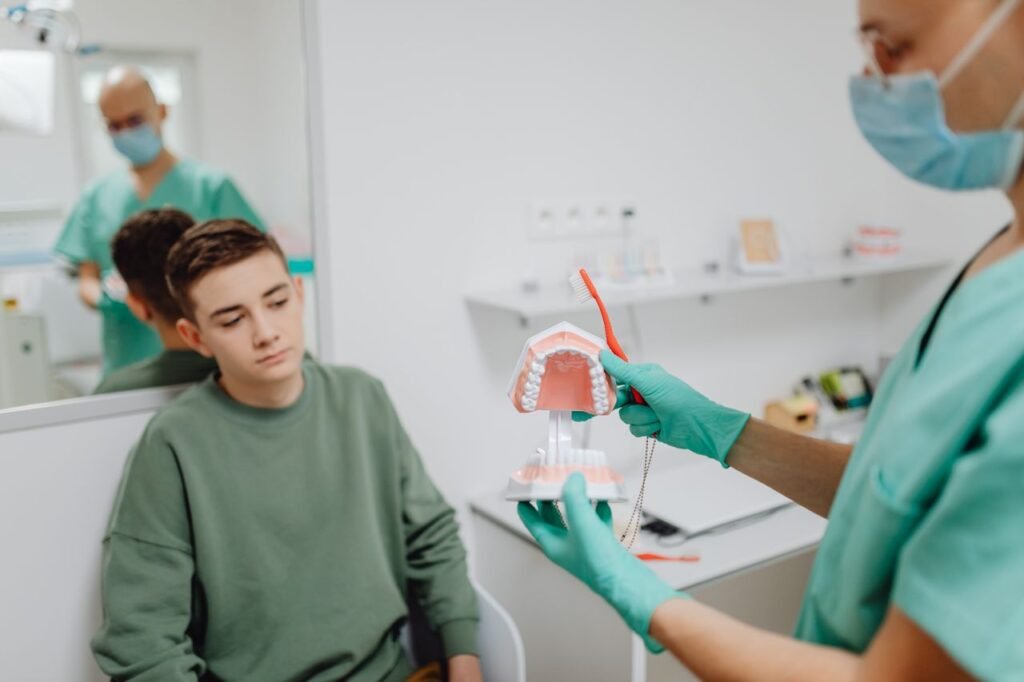
Most children get braces between the ages of 9 and 14, once most of their permanent teeth have come in, but every child should have a first orthodontic check by age 7. That early visit does not usually mean braces right away. It simply allows an orthodontist to spot jaw growth or bite problems while they are easiest to guide. Crooked baby teeth and small gaps are very common and often temporary, while crossbites, severe crowding, and protruding front teeth are the concerns that may benefit from earlier attention.
Parents often worry about two things: starting too early and wasting time, or waiting too long and missing a window. A trusted family team that offers kids dentistry alongside orthodontic care can monitor your child’s growth at every checkup, so the timing decision is based on real changes rather than guesswork.
The right age also depends on the type of treatment. Traditional dental braces remain the most versatile option for complex bites, while some teens do very well with clear aligners. In this guide, we explain what each stage looks like, which signs to watch for, and how to choose the right approach for your child.
Older children and teens who are self-conscious about metal brackets often ask about Invisalign. It can be an excellent choice for suitable cases, and we compare it side by side with braces below. At Peridot Dental Care, families appreciate having pediatric and orthodontic care under one roof, which keeps things simple and familiar for younger patients.
Why Is Age 7 the Recommended First Orthodontic Check?
By around age 7, most children have their first permanent molars and several permanent front teeth. This gives enough information to assess:
- How the upper and lower jaws are growing relative to each other
- Whether the back teeth bite together correctly from side to side
- If there is likely to be enough space for the remaining adult teeth
- Whether habits such as thumb sucking are affecting the bite
The Canadian Association of Orthodontists and similar organizations recommend this early screening because some problems are far easier to correct while the jaw is still growing.
What Is Early (Phase 1) Orthodontic Treatment?
Early treatment, often called interceptive or Phase 1 treatment, usually happens between ages 7 and 10. It focuses on guiding jaw growth and creating space rather than perfecting tooth alignment.
Common Early Treatments
- Palatal expanders widen a narrow upper jaw to correct crossbites and create room.
- Space maintainers hold space after early loss of a baby tooth.
- Partial braces on a few front teeth to fix a crossbite or protect protruding teeth from injury.
- Habit appliances that help children stop thumb sucking or tongue thrusting.
Many children who have early treatment still need a shorter second phase in their teens, but it is often simpler.
Signs Your Child May Need an Orthodontic Evaluation
- Losing baby teeth much earlier or later than usual
- Crowded, overlapping, or blocked-out adult teeth
- Upper front teeth that stick out noticeably
- Lower teeth that bite in front of the upper teeth (underbite)
- Upper teeth that bite inside the lower teeth on one side (crossbite)
- Front teeth that do not meet when back teeth are closed (open bite)
- Jaw that shifts to one side when closing
- Mouth breathing, snoring, or difficulty chewing
- Thumb or finger sucking after age 5
- Speech difficulties linked to tooth position
The Typical Age Ranges for Orthodontic Treatment
| Age | What Usually Happens |
|---|---|
| 6 to 7 | First orthodontic screening |
| 7 to 10 | Early treatment if needed (expanders, partial braces, habit appliances) |
| 10 to 11 | Monitoring as remaining baby teeth are lost |
| 11 to 14 | Most common time for full braces or aligners |
| 15 and up | Treatment still very effective; jaw growth is slowing |
| Adults | Teeth can be moved at any age if gums and bone are healthy |
Invisalign vs Traditional Braces for Kids and Teens
Both options straighten teeth effectively when used for the right cases. The better choice depends on the bite problem and your child’s habits.
| Factor | Traditional Braces | Invisalign Clear Aligners |
|---|---|---|
| Appearance | Visible brackets, clear or coloured options | Nearly invisible |
| Complex cases | Handles almost all cases | Suitable for many mild to moderate cases |
| Compliance | Works full time automatically | Must be worn 20 to 22 hours daily |
| Food restrictions | Avoid sticky, hard, chewy foods | Remove to eat, no food limits |
| Oral hygiene | Harder, needs special tools | Easier, brush and floss normally |
| Emergency visits | Occasional loose brackets or wires | Rare |
| Best for | Younger kids, complex bites, lower compliance | Responsible teens, milder cases, sports and music |
Step-by-Step: Your Child’s First Orthodontic Visit
- Welcome and history. We ask about habits, previous dental care, and any concerns you have noticed.
- Gentle exam. The dentist checks the teeth, bite, jaw movement, and facial profile.
- Photos and X-rays. Images show developing teeth and jaw relationships.
- Discussion. You receive a clear explanation of whether treatment is needed now, later, or not at all.
- Monitoring plan. If treatment can wait, your child is checked periodically as teeth erupt.
This visit is relaxed and usually involves no treatment. Many children find it interesting rather than scary.
Types of Dental Care Your Family May Need Along the Way
Orthodontic treatment is one part of a child’s overall dental journey. A full-service clinic provides:
- General care: checkups, cleanings, fluoride, sealants, and fillings
- Pediatric care: gentle first visits, habit guidance, and preventive programs
- Orthodontic care: braces, clear aligners, expanders, and retainers
- Restorative care: crowns and repairs for damaged teeth
- Cosmetic care: whitening and bonding after braces
- Surgical care: extractions when teeth are blocked or crowding is severe
- Emergency care: broken brackets, sports injuries, and toothaches
What to Expect During the First Week of Braces
Knowing what is normal in the first few days helps children feel prepared and helps parents avoid unnecessary worry.
Days 1 to 3
- Teeth may feel tender when biting as they begin to move. Soft foods like pasta, soups, yogurt, and scrambled eggs make meals easier.
- The inside of the cheeks and lips may feel rough against brackets. Orthodontic wax pressed over a bracket creates a smooth barrier.
- Over-the-counter pain relief suitable for your child’s age may be used as directed by your pharmacist or dentist.
Days 4 to 7
- Tenderness usually fades and eating becomes more comfortable.
- The cheeks toughen up and irritation settles.
- Children start to build a new cleaning routine with threaders or interdental brushes.
When to Call the Clinic
Contact the team if a wire is poking the cheek, a bracket comes loose, or pain is severe rather than mild. Most of these issues are quick to fix and are not true emergencies, although a poking wire can often be seen the same or next day for comfort.
Myths About Children’s Dentistry, Braces, and Sedation
- Myth: “Braces should wait until all adult teeth are in.” Fact: Many problems are best addressed earlier, especially jaw width and crossbites.
- Myth: “Braces are purely cosmetic.” Fact: Correcting bites improves chewing, cleaning, and reduces the risk of tooth wear and injury.
- Myth: “Braces hurt a lot.” Fact: Most children feel pressure and mild soreness for a few days after adjustments, easily managed with soft foods.
- Myth: “Kids who are nervous need to be put to sleep for dental work.” Fact: Most nervous children do well with gentle communication. Mild options such as nitrous oxide are used only when helpful and are closely monitored.
- Myth: “Baby teeth do not matter for orthodontics.” Fact: Baby teeth hold space for adult teeth. Early loss can cause crowding.
Real Family Scenarios
The narrow upper jaw. An eight-year-old had a crossbite on one side. A palatal expander over several months widened the upper jaw. At thirteen, she needed only a short course of braces.
The teen athlete. A fourteen-year-old hockey player with mild crowding chose clear aligners so he could remove them with his mouth guard during games.
Protruding front teeth. A nine-year-old with prominent upper incisors had early treatment to reduce the risk of injury, followed by full braces later.
Does Waiting Too Long Make Braces Harder?
For many bite problems, timing does matter. Once jaw growth slows in the mid to late teens, skeletal issues such as a narrow upper jaw or a significant underbite become harder to correct with appliances alone. In some adults, correcting these problems fully may require a combination of orthodontics and jaw surgery. Simple crowding and spacing, on the other hand, can be treated well at almost any age. This is why early screening is so valuable: it tells you whether your child’s situation is time-sensitive or can safely wait.
Common Parent Mistakes to Avoid
- Waiting until the teenage years for a first orthodontic check
- Assuming a straight smile means the bite is healthy
- Choosing aligners for a child who will not wear them consistently
- Skipping regular cleanings during braces
- Stopping retainer wear after treatment ends
Prevention and Maintenance Tips During Treatment
- Brush after every meal and use a fluoride toothpaste.
- Use floss threaders, interdental brushes, or a water flosser around braces.
- Avoid sticky candy, popcorn, ice, and hard nuts with braces.
- Wear a sports mouth guard designed for orthodontic patients.
- Keep every adjustment and cleaning appointment.
- Wear retainers as instructed to protect the result.
How to Choose the Right Dental Clinic in Woodbridge for Your Child
- Look for a team comfortable with children and experienced in orthodontics.
- Ask whether both braces and clear aligners are offered, so the recommendation fits your child rather than a single system.
- Check that dentists are registered with the Royal College of Dental Surgeons of Ontario (RCDSO).
- Read patient reviews from other families.
- Consider hours that fit school schedules.
Family Orthodontic Care at Peridot Dental Care
Peridot Dental Care is one of the best dental clinics in Woodbridge, with a 4.9 Google rating from more than 165 patient reviews. Families looking for a kids dentist in Woodbridge or an experienced orthodontist in Woodbridge appreciate that the clinic is particularly well regarded for pediatric dentistry and orthodontic solutions, including Invisalign and braces.
The clinic welcomes new patients and CDCP patients, offers a 20% senior discount for patients aged 65 and over, and runs special promotions for kids as well as implant and braces consultations. Evening and weekend appointments make it easier to schedule visits around school and work.
You can visit the clinic at 6175 Highway 7 West, Unit 7, Woodbridge, Ontario, call +1 647-313-4164, or email info@peridotdentalcare.com to book an orthodontic screening. All care is provided by licensed dental professionals registered with the RCDSO, so you can feel confident in the safety and quality of your child’s treatment at this trusted dental clinic in Woodbridge.
Safety Disclaimer
This article provides general guidance and does not replace an individual assessment. Timing and type of orthodontic treatment depend on each child’s growth, bite, and dental health. Please consult a licensed dental professional for personalized advice.
Frequently Asked Questions
Is 7 too young for braces?
Seven is the ideal age for a first check, not necessarily for braces. Most children at this age are only monitored, and treatment starts only if a specific problem benefits from early care.
How long do kids usually wear braces?
Most full treatments take about 18 to 30 months, depending on complexity and how well instructions are followed.
Can my child play sports with braces?
Yes. A properly fitted mouth guard protects both the braces and the mouth during contact sports.
Are clear aligners suitable for younger children?
Some systems are designed for younger patients, but success depends on consistent wear. Your dentist will recommend what suits your child’s case and maturity.
Do all children need braces?
No. Many children develop a healthy bite naturally. An early check simply ensures any issues are caught at the right time.
Conclusion
Most children start braces between 9 and 14, but a first orthodontic check around age 7 is ideal.
Early assessment helps guide jaw growth and often makes later treatment simpler.
Choosing a family-focused team ensures your child’s smile develops safely and confidently.