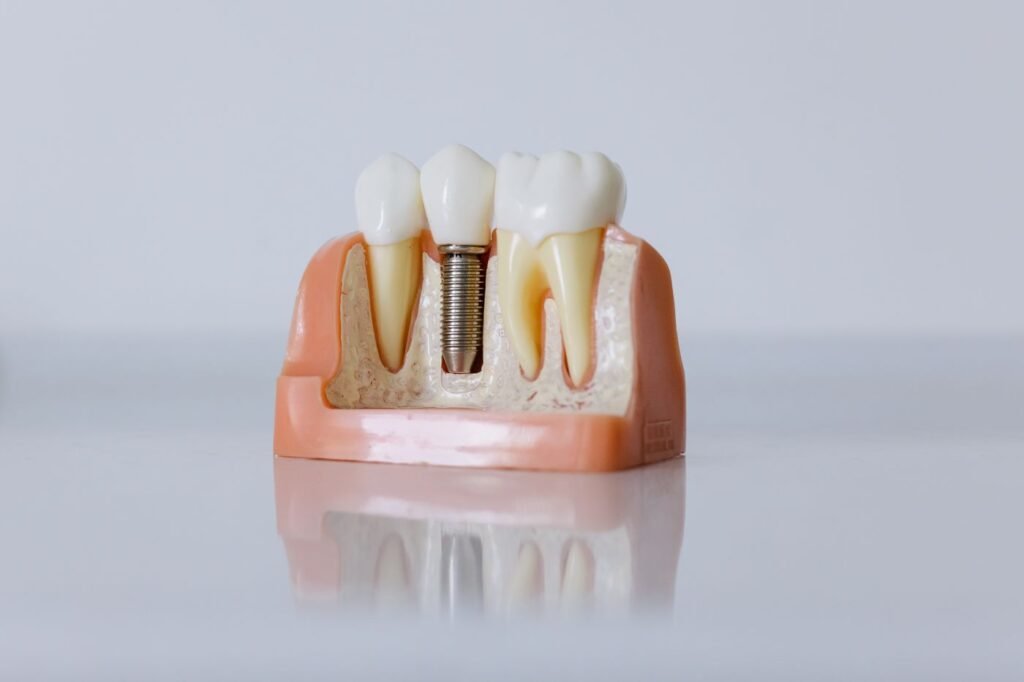
Dental implants cost in Canada varies by province, city, and case complexity, with each province’s dental association publishing its own suggested fee guide and clinics setting final fees based on implant type, grafting needs, and the restoration placed on top. Implants are not covered by provincial health plans, but some private insurance helps with parts of treatment, and the federal CDCP focuses mainly on essential care. Missing teeth are common and implants are a safe long-term fix for most adults, and our Woodbridge dental clinic can explain how Ontario costs compare.
Canadians often research implants across provinces, or even abroad, because they worry about cost and are unsure which clinic to trust. A trusted family clinic offers clear estimates and local follow-up for the life of the implant. Learn more on our dental implants in Woodbridge page.
If an implant is not possible right now, a dental bridge is a proven alternative.
Patients missing all teeth may combine implants with modern dentures to reduce overall cost.
Peridot Dental Care, 6175 Highway 7 West, Unit 7, Woodbridge, Ontario, holds a 4.9 Google rating from 165+ reviews, offers special promotions for implant consultations, gives seniors 65+ a 20% discount, and welcomes new and CDCP patients. Evening and weekend appointments are available at +1 647-313-4164 or info@peridotdentalcare.com.
Why Implant Costs Differ Across Canada
- Each province has its own suggested fee guide
- Urban clinics may have higher overhead
- Specialist versus general dentist placement
- Lab and material costs
- Case complexity
Coverage Across Canada
| Source | Covers implants? | Notes |
|---|---|---|
| Provincial health plans | No | Hospital-based exceptions are rare |
| Private insurance | Sometimes partly | Often covers the crown portion |
| CDCP | Limited | Focused on essential care; check eligibility |
| Health spending accounts | Often | Can be used for eligible costs |
| Medical expense tax credit | Possibly | Ask a tax professional |
Related Dental Services
Implant Steps
- Consultation and 3D scan.
- Written estimate.
- Preparatory treatment if needed.
- Implant placement.
- Healing period.
- Final crown or prosthesis.
Signs You May Need Implants
- Missing teeth
- Loose dentures
- A tooth that cannot be saved

Invisalign vs Braces Before Implants
| Point | Invisalign | Braces |
|---|---|---|
| Space adjustments | Small | Large |
| Visibility | Clear | Visible |
Choosing an Implant Dentist in Canada
Check provincial licensing. In Ontario, look for the Royal College of Dental Surgeons of Ontario (RCDSO). a dentist in Woodbridge candidate will provide clear imaging, brand details, and follow-up.
Patient Scenarios
A patient moving from BC
Records were transferred and the crown was completed in Ontario.
A senior comparing travel options
Local treatment with follow-up support was chosen over going abroad.
Common Mistakes
- Comparing across provinces without equal details
- Travelling abroad without local aftercare
- Ignoring maintenance costs
Complications from implants placed abroad can be difficult to fix locally. Plan aftercare before treatment.
Myths About Sedation and Kids’ Dentistry
Implant Care Tips
- Brush and floss daily
- Keep regular cleanings
- Wear a night guard if you grind
Planning Implant Treatment Anywhere in Canada
General dentist registered with the Royal College of Dental Surgeons of Ontario (RCDSO), practising at Peridot Dental Care in Woodbridge. Last reviewed November 2026. This guide is general information and does not replace an exam with your own dentist.
Implant fees vary from one clinic to another in every province, but the planning questions are the same wherever you live. This section looks at the parts of the cost picture that are national, the parts that depend on your province, and what to do if you move partway through treatment.
What is the same across Canada?
- The Canadian Dental Care Plan (CDCP) is a federal program with the same rules in every province. It excludes dental implants and all implant-related procedures, including implant-supported dentures.
- The federal medical expense tax credit applies across the country. Dental work that is not purely cosmetic, such as replacing a missing tooth, may count, based on the amount you paid yourself.
- The treatment itself follows similar steps everywhere: assessment and imaging, any extraction or grafting, implant placement, healing and the final crown or denture.
What differs from province to province?
- Who regulates dentists. Each province has its own regulatory college. In Ontario it is the Royal College of Dental Surgeons of Ontario (RCDSO).
- Provincial programs. Provinces run their own dental programs for children, seniors or people on social assistance. Routine implant coverage through these programs is rare, so check your own province’s rules.
- Fee guides. Provincial dental associations publish their own suggested fee guides, which insurers often use to calculate payments.
- Local costs. Rent, staffing, lab fees and specialist availability vary between cities and towns.
| Cost element | Mostly national | Mostly local or provincial |
|---|---|---|
| CDCP rules | Yes | No |
| Tax credit rules | Yes | No |
| Clinic fees | No | Yes, set by each clinic |
| Provincial dental programs | No | Yes |
| Insurance reimbursement levels | Plan dependent | Often tied to provincial fee guides |
| Lab and specialist availability | No | Yes |
Moving Provinces During Treatment
Implant treatment can take several months, and people sometimes relocate partway through. A little preparation prevents problems.
- Ask for copies of your 3D scan, X-rays and treatment notes before you move.
- Get the implant brand, system, size and connection type in writing.
- Ask where you are in the healing timeline and what the next step involves.
- Check whether your new dentist works with the same implant system.
- Expect a new estimate for the remaining steps, since fees differ between clinics.
Some implant brands are not widely used in Canada. If you were treated abroad or with a less common system, finding replacement parts for crowns, screws or attachments can be difficult and costly.
Private Insurance: Questions to Ask Wherever You Live
Workplace dental plans in Canada vary widely for implants. Before treatment, ask your insurer:
- Are implants covered, and under which category?
- Is there a separate lifetime or annual maximum for implants?
- Do you pay an alternate benefit equal to a bridge or partial denture instead?
- Is there a missing tooth clause for teeth lost before coverage started?
- Which procedure codes are covered: the implant, the abutment, the crown, grafts?
- Can I get a predetermination before treatment begins?
Ask your clinic to submit separate predeterminations for the graft, the implant and the crown. It is common for one part to be covered when another is not.
Is Travelling for Implants Worth It?
Some Canadians look at treatment in another province or abroad. The headline fee may be lower, but consider follow-up visits, the cost of travel and time off work, the availability of parts, and who will manage complications later. Implants need care for life, so having a local team that knows your case is valuable.
Making Implants More Manageable
- Phase treatment so extractions, grafts and the implant fall in different months or benefit years.
- Graft at extraction if you are likely to want an implant, to avoid a larger graft later.
- Consider implant dentures instead of many single implants when several teeth are missing.
- Look after your gums so implants are not lost to inflammation.
- Keep receipts for the medical expense tax credit.
Coverage and the Canadian Dental Care Plan
The Canadian Dental Care Plan (CDCP) excludes dental implants and all implant-related procedures nationwide. It does cover extractions and conventional complete and partial dentures for eligible members, some with preauthorization, with a co-payment depending on family income. ODSP in Ontario covers dentures but does not list implants for routine tooth replacement. OHIP does not cover implants placed in a dental office.
Dental Implants at Peridot Dental Care
Peridot Dental Care is at 6175 Highway 7 West, Unit 7, Woodbridge, and sees patients from Woodbridge, Vaughan, Kleinburg and Maple. Every plan starts with an exam, a clear explanation of your options and a written estimate before treatment begins. You can learn more about our team and read patient reviews on our about page.
Call 647-313-4164 or book an appointment online to talk through your situation with our dentist.
Learn about dental implants in Woodbridge, read what affects the cost of dental implants in Ontario, see the average cost factors of dental implants, or explore dentures as a covered alternative.
Why do urban and rural implant fees differ?
Clinics in large cities often have higher rent and staffing costs, while clinics in smaller communities may need to refer to specialists further away or send work to distant labs. Neither is automatically cheaper. Comparing complete estimates, including scans, grafts, the abutment and the crown, gives a more accurate picture than comparing the fee for the implant alone.
What ongoing costs should I budget for?
- Regular cleanings and checkups around the implant.
- Occasional crown repairs or replacement after many years.
- Insert changes for snap-on implant dentures.
- A night guard if you grind your teeth.
Frequently Asked Questions
Are dental implants covered in Canada?
Not by provincial plans; private insurance may help.
Does CDCP cover implants?
Coverage is limited; ask the clinic to check.
Are implants cheaper in other provinces?
It depends on the clinic and case.
Can I use a health spending account?
Often, yes.
How long do implants last?
Often decades with good care.
Does any province cover dental implants?
Routine implant coverage through provincial programs is rare. Check your own province’s programs and ask your dentist whether any special medical programs apply to your situation.
Can I start implant treatment in one province and finish in another?
Yes, with good records. Ask for your scans, X-rays, notes and implant details before you move, and check that your new dentist can work with the same system.
Conclusion
Implant costs in Canada vary by province, clinic, and case complexity.
Coverage is limited, so clear estimates matter.
Peridot Dental Care helps Ontario patients plan implants with confidence.